Our mission is to help computational modelers develop, document, and share their computational models in accordance with community standards and good open science and software engineering practices. Model authors can publish their model source code in the Computational Model Library with narrative documentation as well as metadata that supports open science and emerging norms that facilitate software citation, computational reproducibility / frictionless reuse, and interoperability. Model authors can also request private peer review of their computational models. Models that pass peer review receive a DOI once published.
All users of models published in the library must cite model authors when they use and benefit from their code.
Please check out our model publishing tutorial and feel free to contact us if you have any questions or concerns about publishing your model(s) in the Computational Model Library.
Displaying 10 of 1001 results for "George Ak Van Voorn" clear search
An ABM of historic British milk consumption
Matthew Gibson | Published Monday, December 20, 2021Substitution of food products will be key to realising widespread adoption of sustainable diets. We present an agent-based model of decision-making and influences on food choice, and apply it to historically observed trends of British whole and skimmed (including semi) milk consumption from 1974 to 2005. We aim to give a plausible representation of milk choice substitution, and test different mechanisms of choice consideration. Agents are consumers that perceive information regarding the two milk choices, and hold values that inform their position on the health and environmental impact of those choices. Habit, social influence and post-decision evaluation are modelled. Representative survey data on human values and long-running public concerns empirically inform the model. An experiment was run to compare two model variants by how they perform in reproducing these trends. This was measured by recording mean weekly milk consumption per person. The variants differed in how agents became disposed to consider alternative milk choices. One followed a threshold approach, the other was probability based. All other model aspects remained unchanged. An optimisation exercise via an evolutionary algorithm was used to calibrate the model variants independently to observed data. Following calibration, uncertainty and global variance-based temporal sensitivity analysis were conducted. Both model variants were able to reproduce the general pattern of historical milk consumption, however, the probability-based approach gave a closer fit to the observed data, but over a wider range of uncertainty. This responds to, and further highlights, the need for research that looks at, and compares, different models of human decision-making in agent-based and simulation models. This study is the first to present an agent-based modelling of food choice substitution in the context of British milk consumption. It can serve as a valuable pre-curser to the modelling of dietary shift and sustainable product substitution to plant-based alternatives in Britain.
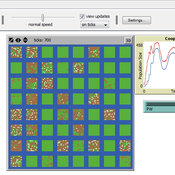
The Evolution of Cooperation in an Ecological Context
Oyita Udiani | Published Saturday, November 03, 2012 | Last modified Saturday, April 27, 2013This is a replication of the altruistic trait selection model described in Pepper & Smuts (2000, 2002).
SLUCEII LUXE (Land Use in an eXurban Environment)
Qingxu Huang Rick L Riolo Shipeng Sun Derek Robinson Dawn Parker Tatiana Filatova Meghan Hutchins Dan Brown | Published Tuesday, September 10, 2013 | Last modified Saturday, October 22, 2022LUXE is a land-use change model featuring different levels of land market implementation. It integrates utility measures, budget constraints, competitive bidding, and market interactions to model land-use change in exurban environment.
An Agent-Based Model of Corruption: Micro Approach
Valery Dzutsati | Published Friday, January 30, 2015 | Last modified Sunday, September 27, 2015Endogenous social transition from a high-corruption state to a low-corruption state, replication of Hammond 2009
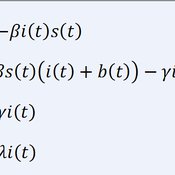
Product Diffusion Model in an Advance Selling Strategy
Peng Shao | Published Tuesday, March 15, 2016 | Last modified Tuesday, March 15, 2016the model can be used to describe the product diffusion in an Advance Selling Strategy. this model takes into account the consumers product adoption, and describe consumer’s online behavior based on four states.
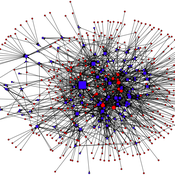
Institutions and Cooperation in an Ecology of Games
Paul Smaldino | Published Wednesday, November 29, 2017Dynamic bipartite network model of agents and games in which agents can participate in multiple public goods games.
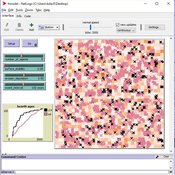
HMODEL: an exploratory simulation of surface archaeological formation
Benjamin Davies Simon Holdaway Patricia Fanning | Published Thursday, November 30, 2017This model is used to simulate the influence of spatially and temporally variable sedimentary processes on the distribution of dated archaeological features in a surface context.
An Agent Based Model of International Capital Flows
Harvey Baldovino | Published Thursday, April 06, 2023This is a preliminary attempt in creating an Agent-Based Model of capital flows. This is based on the theory of capital flows based on interest-rate differentials. Foreign capital flows to a country with higher interest rates relative to another. The model shows how capital volatilty and wealth concentration are affected by the speed of capital flow, number of investors, magnitude of changes in interest rate due to capital flows and the interest differential threshold that investors set in deciding whether to move capital or not. Investors in the model are either “regional” investors (only investing in neighboring countries) and “global” investors (those who invest anywhere in the world).
In the future, the author hopes to extend this model to incorporate capital flow based on changes in macroeconomic fundamentals, exchange rate volatility, behavioral finance (for instance, herding behavior) and the presence of capital controls.
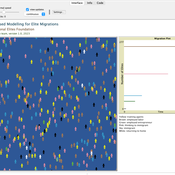
An Agent-Based Model for Skilled Workers Migration
Hassan Bashiri | Published Thursday, September 21, 2023This documentation provides an overview and explanation of the NetLogo simulation code for modeling skilled workers’ migration in Iran. The simulation aims to explore the dynamics of skilled workers’ migration and their transition through various states, including training, employment, and immigration.
The flow of elite and talent migration, or “brain drain,” is a complex issue with far-reaching implications for developing countries. The decision to migrate is made due to various factors including economic opportunities, political stability, social factors and personal circumstances.
Measuring individual interests in the field of immigration is a complex task that requires careful consideration of various factors. The agent-based model is a useful tool for understanding the complex factors that are involved in talent migration. By considering the various social, economic, and personal factors that influence migration decisions, policymakers can provide more effective strategies to retain skilled and talented labor and promote sustainable growth in developing countries. One of the main challenges in studying the flow of elite migration is the complexity of the decision-making process and a set of factors that lead to migration decisions. Agent-based modeling is a useful tool for understanding how individual decisions can lead to large-scale migration patterns.
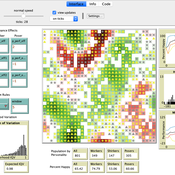
Peer reviewed OfficeMoves: Personalities and Performance in an Interdependent Environment
Alan Dugger | Published Thursday, June 11, 2020After a little work experience, we realize that different kinds of people prefer different work environments: some enjoy a fast-paced challenge; some want to get by; and, others want to show off.
From that experience, we also realize that different kinds of people affect their work environments differently: some increase the pace; some slow it down; and, others make it about themselves.
This model concerns how three different kinds of people affect their work environment and how that work environment affects them in return. The model explores how this circular relation between people’s preferences and their environment creates patterns of association and performance over time.
…
Displaying 10 of 1001 results for "George Ak Van Voorn" clear search